Ātmā
You are not your body
The real you is an eternal spark of consciousness — the soul. Bodies change from childhood to old age, and even from life to life, but the self within is never born and never dies.

The timeless wisdom of the Bhagavad-gītā
Kṛṣṇa consciousness is the ancient science of the soul — a joyful path of devotion that brings lasting peace, purpose and love. It begins with a single, simple sound.
Three simple truths
Beneath the rituals and philosophy lies a message so simple a child can grasp it, and so deep a lifetime can be spent exploring it.
Ātmā
The real you is an eternal spark of consciousness — the soul. Bodies change from childhood to old age, and even from life to life, but the self within is never born and never dies.
Bhagavān
“Kṛṣṇa” means the all-attractive one. The Vedic scriptures describe Him as the source of everything — full of beauty, strength, wisdom and love — and the dearmost friend of every living being.
Bhakti
Our natural state is loving service to Kṛṣṇa. Bhakti-yoga, the yoga of devotion, awakens that dormant love through simple practices anyone can do — no matter their background.
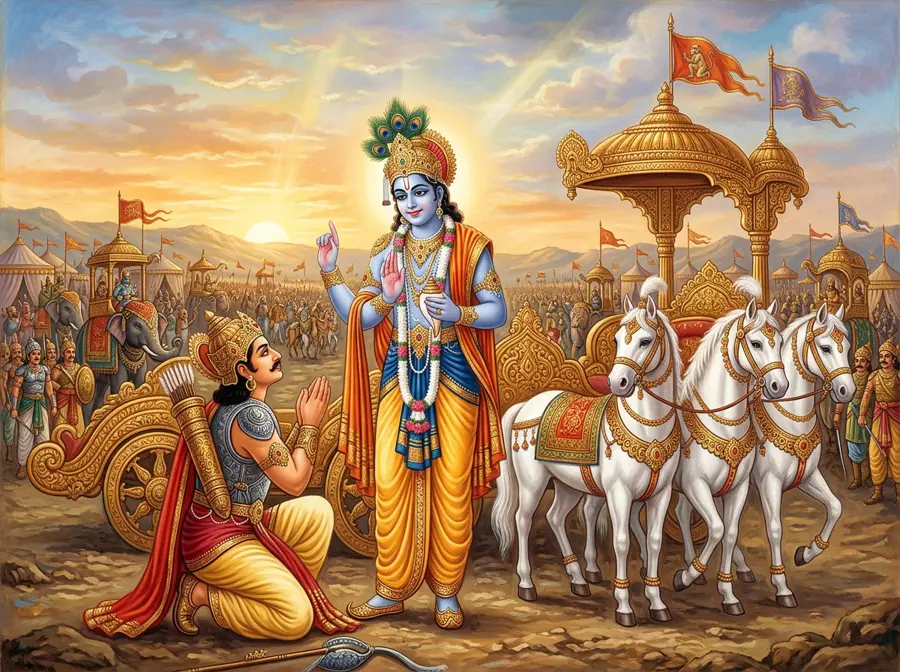
The Song of God
Five thousand years ago, on the eve of a great war, the warrior Arjuna was overwhelmed by grief and doubt. His friend and charioteer, Kṛṣṇa, answered him with 700 verses that became the Bhagavad-gītā — a complete guide to the self, duty, karma, meditation and the path of love.
Arjuna's questions are our questions. Who am I? Why do I suffer? What is the purpose of life? The Gītā answers each one.
The eternal self
“For the soul there is neither birth nor death at any time. He has not come into being, does not come into being, and will not come into being. He is unborn, eternal, ever-existing and primeval. He is not slain when the body is slain.”
The great chant for deliverance
The Vedas recommend chanting God's names as the easiest way to purify the heart in this age. Say each line aloud, gently and attentively — then tap the bead to count one mantra.
Hare Kṛṣṇa Hare Kṛṣṇa
Kṛṣṇa Kṛṣṇa Hare Hare
Hare Rāma Hare Rāma
Rāma Rāma Hare Hare
How to chant: hold a string of 108 beads (or just use the counter here). Chant the full mantra once for each bead, listening carefully to the sound. One full circle is a “round.”
Many practitioners chant 16 rounds daily, but even one heartfelt round — about seven minutes — is a beautiful beginning.
Rounds today: 0
Bhakti in daily life
You don't need to move to a monastery. Bring Kṛṣṇa into the life you already have, one small practice at a time.
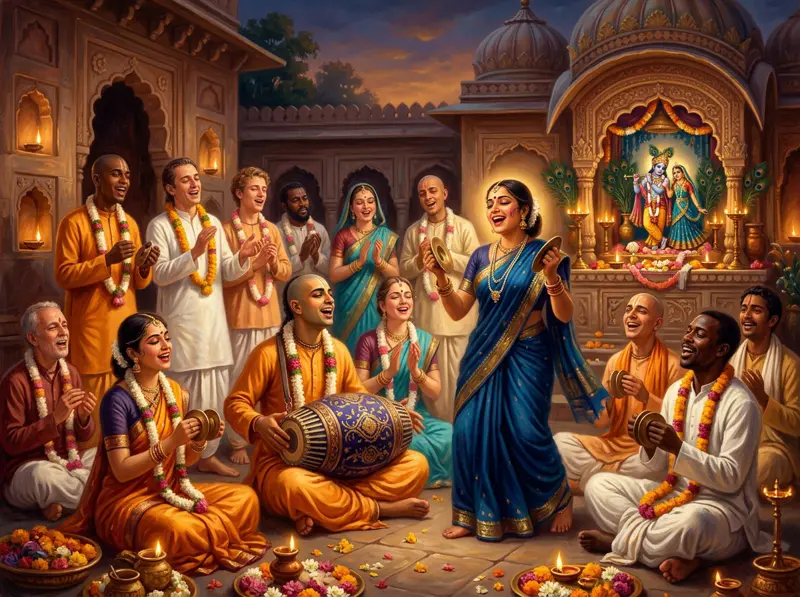
Softly chant the mahā-mantra on beads (japa) or sing it together with others (kīrtana). Start with one round a day.
Ten minutes each morning with the Gītā gives the mind a spiritual anchor for the whole day.
Cook simple vegetarian meals and offer them to Kṛṣṇa with love. The sanctified food is called prasādam — “mercy.”
Spiritual life flourishes in association (saṅga). Visit a temple, join a kīrtana, or connect with a study group online.
Paramparā
The teachings of Kṛṣṇa consciousness are passed down through a disciplic succession, preserving their meaning without change.
Ancient
Recorded in the Mahābhārata by Śrīla Vyāsadeva.
1486
Appears in Bengal and spreads the saṅkīrtana movement of congregational chanting.
1965
At 69, he arrives in New York with little more than a trunk of books.
Today
Temples, farms, schools and kīrtanas in cities across the globe.
Honest answers
Not at all. The Gītā speaks to the soul, and the soul has no nationality. Kṛṣṇa consciousness is practiced today by people of every culture, faith and walk of life on every continent.
The teachings are ancient, recorded in the Vedic scriptures thousands of years ago. They were popularised as the congregational chanting movement by Śrī Caitanya Mahāprabhu in 16th-century Bengal, and brought to the West in 1965 by His Divine Grace A.C. Bhaktivedanta Swami Prabhupāda, who founded ISKCON in New York in 1966.
“Hare” addresses the loving energy of God, “Kṛṣṇa” means the all-attractive one, and “Rāma” means the reservoir of pleasure. Chanting these names is a heartfelt prayer: “Please engage me in Your loving service.”
No. Most practitioners live ordinary lives with families and careers. Bhakti is about adding Kṛṣṇa to the centre of what you already do — your work, your meals, your relationships.
No. Chanting is free, the teachings are freely shared, and our study guide and letters are free as well. There is never a fee to take the holy name.
Receive a free Bhagavad-gītā study guide and gentle weekly letters on chanting, philosophy and practice. A real person reads every message.
“A little advancement on this path can protect one from the most dangerous type of fear.”— Bhagavad-gītā 2.40